


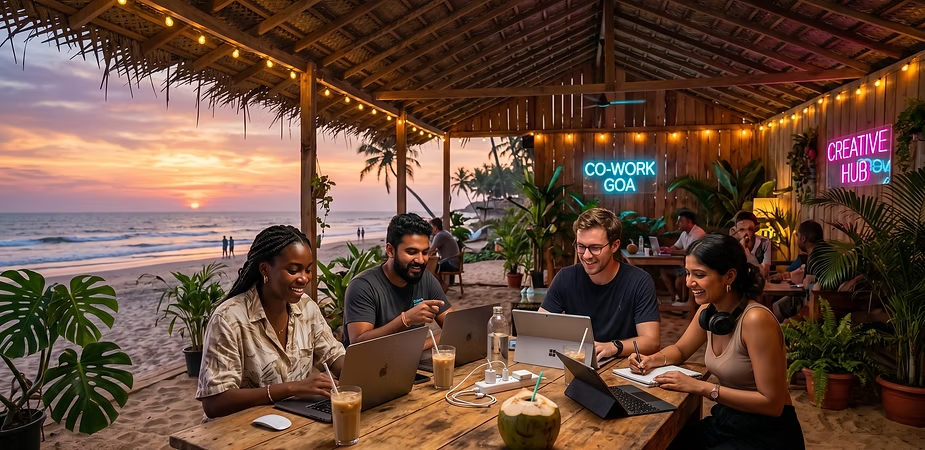
A generation ago, success in the technology industry was defined by a predictable formula: move to a crowded metro city, work long hours inside corporate office towers, and sacrifice lifestyle for opportunity. That model is now rapidly collapsing. Across the world, millions of professionals are rethinking not only where they work, but how they want to live. Remote work, digital entrepreneurship, startup culture, and flexible careers are fundamentally reshaping the global economy—and Goa is positioning itself at the center of that transformation.
What was once viewed primarily as a leisure destination is now emerging as one of Bharat’s most ambitious experiments in future-ready economic development. Through strategic policy interventions, digital infrastructure expansion, startup ecosystem development, and globally resonant initiatives like the upcoming Goa Shackathon, the state is actively redefining itself as a destination where innovation, creativity, technology, and quality of life coexist seamlessly. The message being projected is bold but increasingly credible: the future of work does not belong exclusively to congested megacities anymore. It can thrive from the coastline of Goa just as powerfully as it can from Silicon Valley, Bengaluru, or Singapore.
At the center of this transformation is a growing recognition that the global workforce itself has changed permanently. The COVID-era remote work transition accelerated a trend that was already underway, but by 2026, remote work is no longer merely a temporary adaptation—it has become a defining structural shift in the global labor market. Millions of professionals across technology, design, finance, consulting, digital media, and entrepreneurship now operate independently of traditional office geography. Companies increasingly hire talent across borders, while workers prioritize flexibility, mental well-being, affordability, and lifestyle alongside salary.
Goa’s leadership appears to have recognized this shift earlier than many other regions in Bharat. Rather than resisting the transformation, the state is attempting to capitalize on it strategically by building an ecosystem specifically designed for digital professionals, remote entrepreneurs, startups, freelancers, creators, and innovation-driven industries.
One of the clearest symbols of this evolving vision is the upcoming Goa Shackathon, scheduled to begin on May 21, 2026. Organized by the Department of Information Technology, Electronics and Communications (DITE&C) under the leadership of Rohan Khaunte, the initiative is perhaps one of the most unconventional and globally marketable technology events attempted by any Indian state in recent years.
The concept itself is deliberately disruptive. Instead of organizing another conventional hackathon inside a corporate auditorium or engineering campus, Goa is transforming its iconic beach shacks into temporary collaborative workspaces where startups, developers, designers, digital creators, remote professionals, and innovators can ideate and build solutions in a radically different environment.
On the surface, the Shackathon may appear symbolic or experiential. In reality, however, it reflects a sophisticated understanding of global work culture trends. Around the world, creative productivity is increasingly associated with flexible environments, community-driven workspaces, wellness integration, and non-traditional collaborative ecosystems. Major innovation hubs globally now prioritize creativity-enhancing spaces rather than rigid office structures. Goa is adapting that philosophy to its own cultural and geographical identity.
Participants at the Shackathon are expected to engage in problem-solving exercises, startup collaboration, digital entrepreneurship discussions, and technology innovation workshops while simultaneously experiencing the lifestyle ecosystem Goa naturally offers. By integrating wellness activities, watersports, networking, and experiential collaboration into the event architecture, the state is effectively marketing Goa as a location where professional excellence and personal well-being can coexist rather than compete.
This positioning aligns remarkably well with broader global employment data. According to multiple international market analyses, the digital nomad services economy is witnessing explosive growth. The global digital nomad market, valued at approximately $44 billion in 2025, is projected to cross $54 billion in 2026 and potentially exceed $100 billion before the end of the decade. Industry estimates suggest that there are currently more than 35 million digital nomads worldwide, while long-term forecasts indicate that location-independent work could become mainstream for hundreds of millions of professionals globally by 2035.
Goa’s strategy is therefore not ideological—it is deeply economic. The state is attempting to position itself early within one of the fastest-growing workforce transitions of the century.
Importantly, Goa possesses several natural competitive advantages in this emerging market. Unlike hyper-urbanized metropolitan centers struggling with congestion, pollution, burnout, and rising living costs, Goa offers a fundamentally different lifestyle proposition. The state combines natural beauty, cultural richness, international familiarity, comparatively lower stress environments, strong hospitality infrastructure, and improving connectivity within a relatively compact geography.
For remote professionals earning global incomes, lifestyle quality increasingly influences relocation decisions. The modern digital workforce prioritizes factors such as climate, safety, internet reliability, wellness access, food culture, affordability, and community ecosystems alongside pure business opportunity. Goa’s ability to naturally satisfy many of these criteria gives it a strategic advantage over more conventional business destinations.
However, the transformation extends beyond attracting foreign remote workers. Perhaps the most important long-term implication of Goa’s emerging innovation ecosystem lies in its impact on local youth and employment patterns. For decades, ambitious Goan students pursuing engineering, technology, design, and startup careers often felt compelled to leave the state in search of opportunities elsewhere. Cities such as Bengaluru, Pune, Hyderabad, Mumbai, and international destinations became magnets for skilled Goan talent, contributing to a persistent brain-drain challenge.
The emergence of a localized startup and innovation ecosystem has the potential to fundamentally alter this dynamic. When startup founders, investors, remote companies, digital agencies, and technology professionals begin operating from within Goa itself, local students gain direct access to mentorship, internships, networking, and employment opportunities without leaving the state.
A student graduating from Goa Engineering College or National Institute of Technology Goa no longer necessarily needs to relocate immediately in order to engage with the global technology economy. The ecosystem itself is gradually beginning to form locally.
This ecosystem-building process is also being reinforced through broader policy support mechanisms. Goa’s Startup Policy, digital governance initiatives, innovation incentives, and technology infrastructure expansion collectively indicate an attempt to create a sustainable knowledge economy rather than relying solely on tourism-driven growth.
Economically, this diversification is extremely significant. Tourism will remain a foundational pillar of Goa’s economy, but excessive dependence on seasonal tourism creates vulnerabilities. International travel disruptions, geopolitical instability, environmental pressures, and fluctuating tourist demand can all impact economic stability. By cultivating a parallel innovation and remote-work economy, Goa is gradually broadening its revenue and employment base.
The distinction between traditional tourism and long-term remote-work residency is particularly important. Conventional tourists typically stay for short durations and contribute episodically to the economy. In contrast, remote professionals and startup founders often become medium-term or long-term residents. They rent apartments, subscribe to internet services, frequent local cafes and businesses daily, hire local services, join fitness centers, engage with local communities, and contribute more consistently to the local economy throughout the year.
This creates a more stable economic cycle that benefits not only hospitality businesses, but also real estate owners, local retailers, food businesses, transportation providers, wellness services, creative industries, and technology support ecosystems.
Infrastructure development remains central to making this transformation viable. Lifestyle branding alone cannot sustain a serious innovation economy. Reliable digital infrastructure is non-negotiable for modern remote professionals, and Goa has increasingly prioritized this requirement through expanded connectivity initiatives.
The Department of Information Technology and associated agencies are reportedly facilitating improved public Wi-Fi infrastructure, encouraging higher-speed broadband penetration, and supporting the expansion of 4G and 5G connectivity across key coastal and urban belts. Internet reliability is perhaps the single most critical operational requirement for remote professionals, and Goa’s competitiveness will depend heavily on maintaining global-standard digital consistency.
Simultaneously, purpose-built co-working and co-living infrastructure is rapidly expanding across regions such as Assagao, Anjuna, Vagator, Morjim, Ashvem, Porvorim, and Panaji. Heritage villas are being converted into collaborative workspaces, cafes are evolving into remote-work hubs, and developers are increasingly targeting long-stay digital residents rather than exclusively focusing on transient tourism.
Physical connectivity improvements are also strengthening Goa’s strategic position. The combined operational ecosystem of Goa International Airport and Manohar International Airport significantly improves domestic and international accessibility. Simultaneously, ongoing highway expansions and transport upgrades further integrate Goa into larger economic corridors.
Yet perhaps the most powerful element of Goa’s emerging narrative is psychological rather than infrastructural. Across the world, professional burnout has become a defining challenge of modern work culture. Long commutes, hyper-competitive urban environments, isolation, and poor work-life integration are increasingly driving professionals to reconsider traditional career models.
Goa is positioning itself as an antidote to that exhaustion.
The broader narrative being constructed is not simply about “working from the beach.” It is about creating a model where productivity, innovation, creativity, and personal well-being reinforce each other instead of existing in conflict. The state is effectively branding itself as a location where people can build globally relevant careers without sacrificing lifestyle quality, mental health, community, or environmental connection.
This positioning is especially relevant for younger generations entering the workforce. Millennials and Gen Z professionals increasingly prioritize flexibility, purpose, wellness, and experiential quality alongside financial success. Traditional corporate environments no longer hold the same aspirational dominance they once did. Regions capable of offering integrated lifestyle-work ecosystems are therefore likely to attract disproportionate attention over the coming decade.
Goa’s evolving strategy reflects a broader recognition that future economies will compete not only through infrastructure and taxation, but also through quality of life. The ability to attract talent may become just as important as the ability to attract capital.
Challenges certainly remain. Housing affordability, infrastructure scalability, environmental sustainability, waste management, traffic planning, and balancing local community interests with incoming professional migration will require careful governance. The state must ensure that growth remains inclusive and sustainable rather than creating displacement pressures or unsustainable commercialization.
At the same time, Goa’s opportunity is undeniably enormous. Very few regions possess the combination of cultural familiarity, natural appeal, international brand recognition, emerging digital infrastructure, startup policy momentum, and lifestyle attractiveness that Goa already holds organically.
The upcoming Goa Shackathon is therefore far more than a standalone event. It symbolizes a broader economic transition already underway—a shift from positioning Goa solely as a tourism destination toward establishing it as a globally relevant innovation ecosystem.
Ultimately, the transformation underway is about redefining what economic development can look like in the 21st century. Goa is no longer merely selling vacations; it is increasingly selling possibility. The possibility that work itself can be redesigned. The possibility that innovation can emerge outside conventional corporate geography. The possibility that economic growth and quality of life do not need to exist in opposition.
As the global workforce continues evolving toward flexibility, mobility, and digital collaboration, Goa appears determined not simply to adapt to the future of work—but to actively shape it.