


Goa’s Net Positive Panchayat initiative integrates climate action, scientific data, and local governance across three pilot villages.Carbon assessments, energy audits, community participation, and government coordination are helping panchayats develop measurable sustainability plans. The initiative could establish a statewide roadmap for climate-smart development across all 191 village panchayats.
At a Glance
- Three pilot panchayats demonstrate Goa’s scalable climate-smart village governance model.
- Scientific carbon assessments guide evidence-based planning across diverse local communities.
- Calangute’s energy audit informs statewide efficiency policies and sustainable tourism.
- Multiple government departments coordinate renewable energy, waste, water, green livelihoods.
- Goa aims to expand climate governance across 191 village panchayats.
Goa Net Positive Panchayat Initiative: Climate Action Begins Locally
Climate change is usually discussed through national commitments, international agreements, and large infrastructure projects. However, meaningful progress also depends on decisions made within villages: how electricity is consumed, how waste is managed, how water is conserved, and how natural resources are protected.
The Goa Net Positive Panchayat initiative addresses these challenges through an integrated approach to village-level climate governance. Instead of treating environmental activities as isolated projects, the programme combines carbon assessment, community planning, government coordination, and practical interventions.
Implemented in Harvalem, Calangute, and Caurem Pirla, the initiative creates a framework for incorporating sustainability into everyday Goa panchayat governance.
Its larger ambition is to develop a roadmap capable of guiding climate action across all 191 village panchayats in Goa.
Read Also: Goa Government Steps Up Infrastructure Development Across Industrial Estates
What Is a Net Positive Panchayat?
A Net Positive Panchayat is a village-level governance model that aims to improve environmental, social, and economic conditions while reducing greenhouse gas emissions.
Unlike initiatives focused exclusively on carbon neutrality, this approach addresses multiple interconnected priorities:
- Renewable energy and energy efficiency.
- Water conservation and rainwater harvesting.
- Waste segregation and resource recovery.
- Sustainable agriculture and biodiversity protection.
- Green livelihoods and community participation.
The concept goes beyond reducing environmental harm. It encourages panchayats to generate measurable improvements in local ecosystems, public services, and economic opportunities.
For Goa, this creates a practical connection between climate responsibility and development outcomes that residents experience directly.
Three Goa Panchayats, Three Different Development Realities
The initiative is being tested in three distinct locations:
Harvalem represents a predominantly rural setting where agriculture, community infrastructure, and natural resources influence development priorities.
Calangute reflects a tourism-driven economy with significant commercial activity, higher electricity demand, and complex waste-management requirements.
Caurem Pirla represents a remote tribal context, where accessibility, livelihoods, and community participation require locally appropriate solutions.
These contrasting conditions help determine which elements of the Net Positive Panchayat framework can be standardised across Goa and which must be adapted to individual communities.
The pilots also demonstrate that effective climate governance cannot depend on a single solution for every village.
Read Also : Quality Care, Minimal Cost: How Goa is Defeating India’s Medical Burden Under CM Dr. Pramod Sawant
Carbon Assessment Brings Scientific Evidence Into Panchayat Planning
A major contribution of the Goa Net Positive Panchayat initiative is the development and testing of a dedicated carbon assessment tool.
The tool helps panchayats identify greenhouse gas emissions across locally relevant sectors, including electricity consumption, transport, waste, agriculture, livestock, and commercial activity.
It also considers natural assets that can support carbon absorption and ecological restoration.
This information allows local governments to establish emissions baselines, identify priority sectors, and evaluate potential interventions.
Rather than relying on assumptions, panchayats can use measurable evidence to shape development decisions.
Nearly 300 representative household and commercial surveys have supported the assessment process. Resource mapping, consultations, and sector-specific studies have further strengthened the evidence available for local planning.
Calangute Energy Audit Creates a Blueprint for Wider Action
Calangute’s tourism economy makes energy consumption a particularly important governance issue.
Hotels, restaurants, commercial establishments, households, and public infrastructure contribute to electricity demand that differs considerably from rural panchayats.
A detailed energy audit examined these consumption patterns and identified opportunities to improve efficiency.
Potential interventions include energy-efficient lighting, upgraded electrical systems, efficient equipment, rooftop solar installations, and improved energy-management practices.
The findings have also informed a policy proposal for extending energy assessments and efficiency measures to additional panchayats and relevant establishments.
For tourism-intensive areas, this approach could reduce operating costs, lower emissions, and strengthen Goa’s reputation as a responsible tourism destination.
Read Also : Goa’s Solar Energy Revolution: Here’s How the Govt Is Making It Cheaper
Government Coordination Turns Climate Plans Into Action
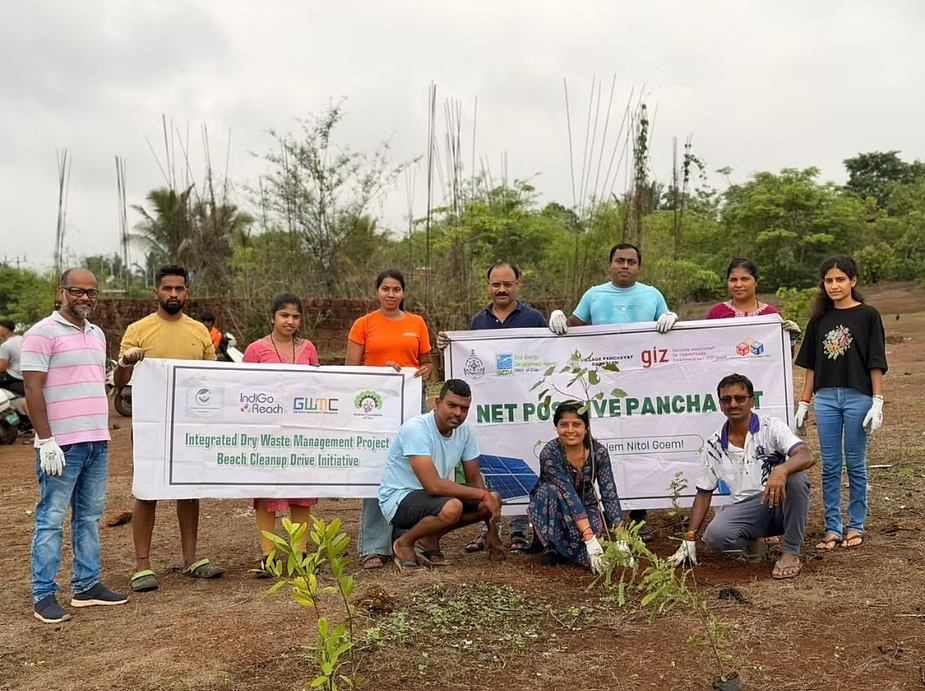
The initiative is implemented by the Foundation for MSME Clusters in partnership with the Goa Energy Development Agency and Deutsche Gesellschaft für Internationale Zusammenarbeit.
Under the current Goa government led by Chief Minister Dr. Pramod Sawant, the initiative connects renewable energy, environmental management, and local development through an institutional framework involving multiple departments.
Participating organisations include the Directorate of Panchayats, Goa State Rural Livelihood Mission, Goa Waste Management Corporation, Water Resources Department, Forest Department, Goa State Biodiversity Board, Directorate of Agriculture, Electricity Department, and Department of Tourism.
More than 12 departments and agencies have contributed to consultations, planning, and implementation.
This coordination matters because a single village project may require technical expertise, government funding, community participation, and private-sector or corporate social responsibility support.
Visible Results Across Energy, Waste, Water, and Livelihoods
The pilot programme has already produced practical interventions across participating communities.
Twenty-eight solar streetlights have been installed at identified dark spots, improving visibility and supporting renewable energy adoption.
Two schools have been assessed for rooftop solar, while two potential electric-vehicle charging locations have been identified.
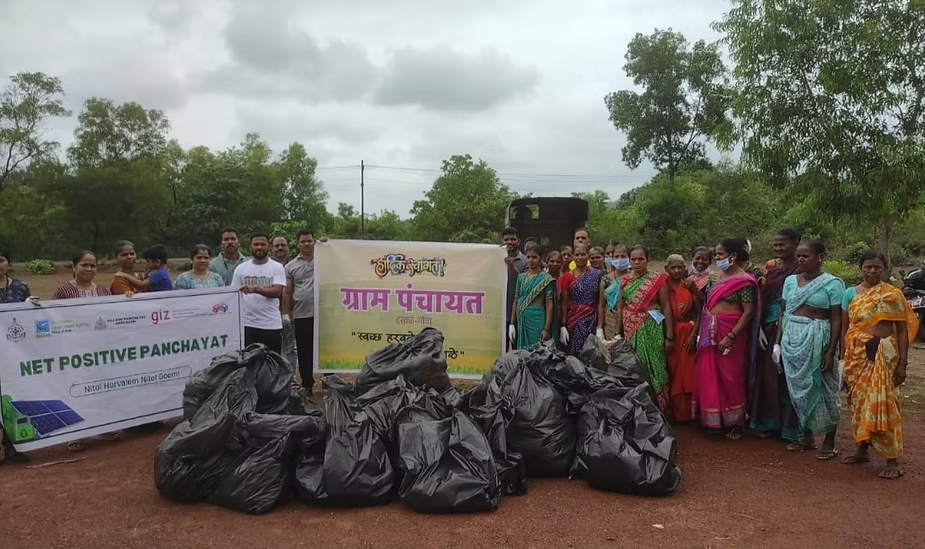
Waste-management activities have included support for Material Recovery Facilities, improved segregation systems, school awareness programmes, and an exposure visit for facility operators.
Water conservation measures include identified rainwater-harvesting opportunities in two schools and plans for a community conservation structure supported through corporate social responsibility.
The initiative has also planted or distributed more than 285 saplings, engaged over 200 farmers in sustainable agriculture programmes, and introduced more than 85 women from self-help groups to renewable energy and green livelihood opportunities.
These activities connect environmental improvements with public safety, resource efficiency, agriculture, and local employment.
Read More: Monsoons Are No Longer an Off-Season for Goa
Community Participation Strengthens Goa Panchayat Governance
Effective panchayat governance requires more than technical assessments and departmental meetings. Residents must participate in identifying priorities and shaping local solutions.