


Goa is stepping up efforts to reduce its dependence on agricultural produce brought in from neighbouring States, with the Indo-Israel Centre of Excellence for Vegetables and Flowers at Codar emerging as a key part of the State’s strategy to strengthen local farming.
The Indo-Israel Centre of Excellence for Vegetables and Flowers at Codar, which has completed one year of operations, was established under the Indo-Israel Agriculture Project with the support of the Governments of India and Goa.
With an investment of around ₹12 crore, the facility aims to help Goan farmers access quality seedlings, modern cultivation technology, and technical guidance to improve productivity and farm incomes.
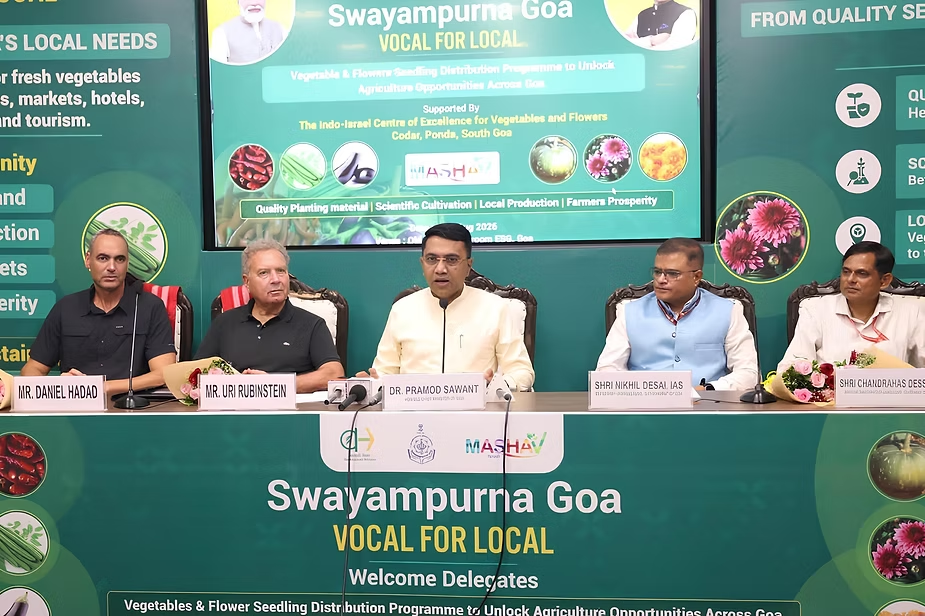
Chief Minister Dr. Pramod Sawant, speaking at a seedling distribution programme in Panaji, said the facility will play an important role in strengthening agricultural production and increasing farmers’ incomes in Goa.
Quality Seedlings to Strengthen Local Farming
One of the major objectives of the Indo-Israel Centre of Excellence for Vegetables and Flowers at Codar is to produce quality seedlings on a large scale and promote protected cultivation. The facility is equipped with automated greenhouse infrastructure, irrigation and fertigation systems, along with technology-based cultivation practices.
The initiative also focuses on building the capacity of farmers and Agriculture Department officials through technical expertise from Israel.
CM Sawant stressed that access to healthy and quality planting material is essential for improving agricultural production. He said farmers sometimes depend on unregulated nurseries or purchase plants brought from neighbouring States without knowing their quality or whether they are carrying diseases.
By making quality seedlings available locally, the government aims to reduce this risk while giving farmers better planting material for commercial cultivation.
Read More: Goa Targets Up to 8,000 New Jobs in Six Months
Marigold Cultivation Seen as a New Income Opportunity
The latest seedling distribution programme provided farmers with marigold and musk melon seedlings, with Chief Minister Pramod Sawant urging them to take up marigold cultivation on a larger scale.
Goa currently spends substantial amounts on flowers sourced from outside the State, especially during periods of high demand such as Dussehra and Diwali. CM Sawant said increasing local marigold production could help retain this money within Goa and create a direct income opportunity for farmers.
Seedlings worth around ₹12 lakh have already been distributed under the programme. The Chief Minister urged farmers to cultivate the crop systematically and focus on taking their produce to the market.
CM Sawant said the larger objective is to position flower cultivation as a viable source of income for farming families, rather than treating flowers merely as agricultural produce.
Connecting Farmers Directly with Buyers
Production alone, however, cannot make agriculture commercially successful without a reliable market. Recognising this gap, CM Sawant called for regular Buyer-Seller Meets to connect farmers directly with bulk purchasers.
Temples, flower vendors, hotels and other institutions represent significant markets for locally grown flowers and agricultural products. Better coordination between growers and buyers could help farmers access these markets without depending heavily on intermediaries.
Such direct market linkages could also ensure that demand within Goa translates into income for Goan farmers rather than benefiting producers from outside the State.
Read More: A New Ride for Goa: How New KTCL Buses Will Transform Public Transport
Goa Fresh to Bring Farm-to-Market Traceability
The government is also planning to introduce QR coding under the Goa Fresh brand, allowing consumers to identify the farmer and eventually trace agricultural produce from the farm to the market.
The move is expected to improve transparency and give consumers greater information about the source and quality of the food they purchase. At the same time, traceability could help strengthen the identity and market value of locally produced agricultural commodities.
From Farmers to Agricultural Entrepreneurs
CM Sawant said the government’s larger vision is to transform farmers into entrepreneurs who can build sustainable businesses around agriculture.
Goa has a significant demand for fish, milk, flowers, fruits and other agricultural products, particularly from hotels, five-star properties and major events. The Chief Minister called on Agriculture Department officials and field staff to identify commodities that can be produced within the State to meet this demand.
This approach would allow agriculture to move beyond subsistence farming and create stronger commercial opportunities by connecting local production with local consumption.
Read More: Goa Just Deleted 9,525 ‘Ghost’ Electricity Accounts: Here’s What That Means for You
Making Better Use of Fallow Land
The government is also looking at ways to put Goa’s fallow agricultural land to productive use. Sawant called on women’s self-help groups under the Rural Development Department to consider using such land, particularly for fodder production.
With demand for fodder remaining high among livestock owners, the initiative could create an additional income-generating activity while bringing unused agricultural land back into productive use.
Government departments, he said, could provide the necessary technology and support to facilitate such activities.
Focus on Organic and Natural Farming
Alongside modern agricultural technology, the Chief Minister stressed the importance of protecting soil health through organic and natural farming practices.
He encouraged greater use of cow dung and organic manure and pointed to Goa’s naturally grown crops such as cashew and jackfruit as examples of the State’s agricultural potential.
The emphasis is on combining modern cultivation methods with sustainable practices so that increased agricultural production does not come at the cost of long-term soil health.
Read More: Goa Strengthens Education and Employment with 222 New Teacher Appointments
Supporting Local Farmers
CM Sawant also appealed to consumers to give preference to locally grown agricultural produce rather than choosing outside products simply because they are marginally cheaper.
He urged people to recognise farmers as the providers of food and said supporting local farmers would directly strengthen Goa’s rural economy.
The Chief Minister also encouraged farmers receiving seedlings through government programmes to cultivate them seriously and share information about their earnings with the Agriculture Department. Measuring the economic returns from such initiatives, he said, would help determine their success and guide future expansion.
Conservation Alongside Agricultural Growth
The programme also highlighted the importance of protecting Goa’s natural resources. Sawant appealed to fishers to release egg-bearing female crabs back into the water to support the regeneration of crab populations.
He said a female crab can carry a large number of eggs and that protecting breeding females could contribute significantly to sustaining future stocks. The appeal reflected the broader need to combine economic activity with responsible management of natural resources.
Towards Atmanirbhar Bharat and Swayampurna Goa
The initiatives form part of the government’s wider vision of Atmanirbhar Bharat, Swayampurna Goa and Viksit Bharat, with agriculture positioned as an important pillar of economic self-reliance.
The Indo-Israel partnership provides Goa with access to modern cultivation technologies, while government efforts on quality seedlings, market linkages, traceability and use of fallow land aim to create an ecosystem in which farmers can produce, market and earn more within the State.
With the Amrit Kaal Agriculture Policy and several programmes planned for implementation, the focus is increasingly shifting from simply increasing agricultural production to creating profitable, market-driven and technology-enabled farming opportunities.
For Goa, the goal is clear produce more locally, reduce dependence on supplies from outside the State and ensure that the money spent on food and flowers reaches the farmers who grow them.
Read More: Porvorim’s Elevated Corridor set for Inauguration on 10 September, Boosting North Goa’s Connectivity