

A landmark education reform aims to remove long-standing barriers for vocational students and place skills on par with mainstream academic qualifications.
At a Glance
- Goa has introduced direct SSC and HSSC equivalence certificates for eligible ITI graduates.
- The reform was notified through Notification No. GBSHSE/Acad/ITI/2025/1969 dated September 22, 2025, followed by a corrigendum issued in January 2026.
- Eligible Industrial Training Institute graduates can now obtain certificates equivalent to Secondary School Certificate and Higher Secondary School Certificate qualifications.
- The move enables vocational students to pursue higher education, compete for more government and private sector jobs, and improve long-term career mobility.
- The initiative strengthens Goa’s strategy of integrating skill development with formal education.
Skills Finally Receive Academic Recognition
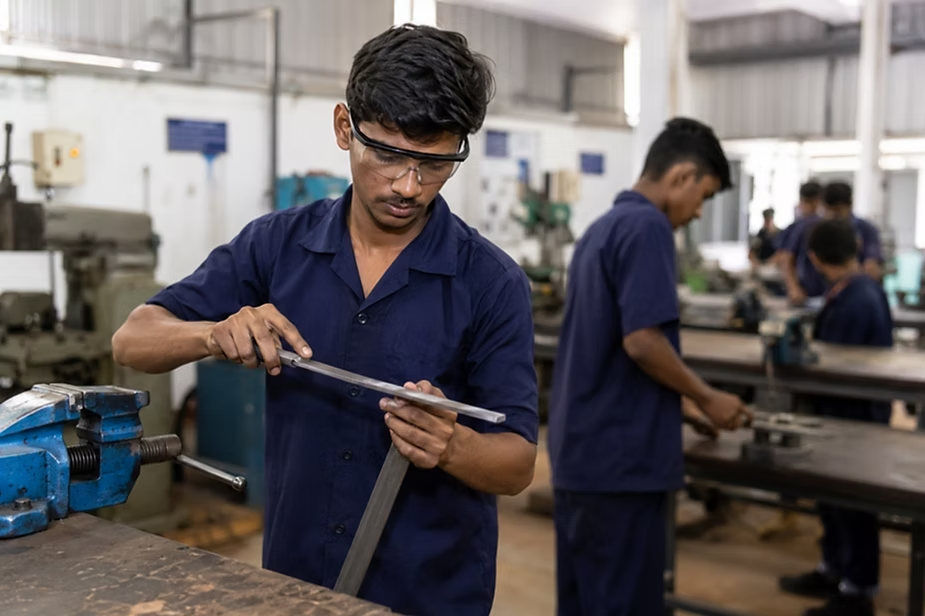
For decades, thousands of students across Goa chose Industrial Training Institutes over conventional higher secondary education. They became electricians, fitters, welders, mechanics, computer operators, refrigeration technicians and skilled craftsmen who powered industries, tourism, construction, manufacturing and public infrastructure. Yet many of these young professionals faced a common obstacle. While they possessed nationally recognised trade certificates and practical expertise, they often lacked the formal academic qualification required for university admissions, government recruitment or career progression.
The result was a paradox. Students with employable technical skills frequently found themselves unable to compete for opportunities where an SSC or HSSC certificate was mandatory. Their vocational education prepared them for work, but not always for further learning or administrative eligibility.
That gap is now being addressed through a significant policy intervention by the Government of Goa.
The state has introduced an initiative granting eligible ITI graduates direct academic equivalence to the Secondary School Certificate and Higher Secondary School Certificate. Issued through the Goa Board of Secondary and Higher Secondary Education, the reform creates a bridge between vocational education and mainstream academics.
Although the decision may appear administrative, its implications are much broader. It signals an evolution in how vocational education is viewed in Goa, placing practical skills alongside traditional academic pathways instead of treating them as separate streams.
For students, it means more choices. For employers, it means a larger pool of academically eligible skilled workers. For the education ecosystem, it represents another step towards recognising that modern economies require both theoretical knowledge and technical competence.
Bridging the Divide Between Skills and Formal Education
The Goa Board of Secondary and Higher Secondary Education notified the initiative through Notification No. GBSHSE/Acad/ITI/2025/1969 dated September 22, 2025, with a corrigendum issued in January 2026.
The reform enables eligible Industrial Training Institute graduates to receive SSC or HSSC equivalent certificates under the framework prescribed by the Board.
This represents a major simplification compared to earlier arrangements.
Historically, ITI students seeking academic equivalence had to fulfil additional examination requirements in prescribed language subjects before becoming eligible for SSC or HSSC equivalence. The system was often viewed as complicated and was not widely understood among students or employers.
The revised framework seeks to reduce these procedural barriers by creating a more direct pathway for eligible candidates while preserving academic standards established by the Board.
The initiative also aligns vocational education with India’s larger education reforms that emphasise multiple learning pathways, lifelong learning and flexible academic mobility.
For Goa, where tourism, manufacturing, shipbuilding, electronics, hospitality, pharmaceuticals and infrastructure increasingly require technically trained manpower, recognising vocational education through formal academic equivalence carries both educational and economic significance.
Why This Reform Could Change Thousands of Careers
Education qualifications continue to determine access to opportunities across India.
Whether applying for undergraduate programmes, government recruitment, banking examinations, police services, public sector employment or competitive examinations, SSC and HSSC certificates remain fundamental eligibility requirements.
Many technically skilled candidates previously found themselves excluded despite possessing valuable industrial qualifications.
The new equivalence system changes that equation.
An eligible ITI graduate who receives an SSC or HSSC equivalent certificate gains access to educational pathways that were previously difficult or impossible to enter.
These include:
- Undergraduate degree programmes where HSSC is a prerequisite.
- Diploma and technical education programmes requiring SSC or HSSC eligibility.
- Government recruitment where minimum educational qualifications specify SSC or Higher Secondary education.
- Competitive examinations that require recognised academic qualifications.
- Career progression within both public and private organisations.
The reform also helps remove the long-standing perception that vocational education represents a lesser academic pathway.
Instead, it acknowledges that technical education demands rigorous training, practical competence and nationally standardised assessments that deserve formal academic recognition.
This shift is consistent with the broader objectives of India’s National Education Policy, which encourages seamless movement between vocational and academic streams rather than maintaining rigid divisions between the two.
A Long Journey Towards Academic Mobility
Goa has supported vocational education for several decades through its network of Government Industrial Training Institutes under the Directorate of Skill Development and Entrepreneurship.
These institutions offer training across numerous engineering and non-engineering trades that respond directly to labour market demand.
The state has also gradually expanded what it describes as “vertical mobility” for ITI graduates.
Existing policies already allow eligible candidates to pursue direct second-year admission into selected diploma engineering programmes under specified conditions. ITI graduates can also enter apprenticeship programmes governed by the Apprentices Act and participate in entrepreneurship initiatives supported by both the State and Central Governments.
Earlier academic equivalence provisions also existed.
Under the previous framework, students completing recognised ITI programmes could obtain SSC or HSSC equivalence after fulfilling additional subject requirements prescribed by the Goa Board. Candidates typically needed to appear as private candidates in specified language subjects before equivalence could be granted.
While functional, that system required additional procedural steps that many students found difficult to navigate.
The latest notification simplifies the pathway and reflects an evolving policy approach that seeks to integrate vocational education more closely with mainstream education.
It also builds upon years of institutional efforts to improve educational mobility rather than introducing an entirely new concept.
The Directorate of Skill Development and Entrepreneurship has consistently promoted vertical mobility, encouraging ITI graduates to continue into diploma education, university programmes, apprenticeship opportunities and entrepreneurship schemes. The new equivalence initiative strengthens that continuum by addressing one of the most important academic barriers faced by vocational students. (dsde.goa.gov.in)
What This Means for Ordinary Goan Families
For many families, particularly those seeking early employment after school, Industrial Training Institutes represent one of the most affordable and practical routes into the workforce.
Students often complete vocational education faster than traditional academic programmes and enter employment in sectors experiencing consistent demand.
However, career aspirations frequently evolve.
A technician may later wish to become an engineer.
An electrician may aspire to complete a degree in management.
A fitter may decide to prepare for government recruitment.
Until now, the absence of recognised academic qualifications could become an unexpected obstacle.
The new policy reduces that barrier.
Students no longer have to choose between skills and academics as permanently separate futures.
Instead, vocational education can become the first stage of a much longer educational journey.
Families also stand to benefit financially.
Rather than restarting academic education from an earlier stage, eligible candidates can build upon their existing qualifications and continue progressing through higher education more efficiently.
Industries may also benefit from employees who combine practical technical skills with advanced academic qualifications over time.
As Goa continues investing in manufacturing, logistics, electronics, renewable energy, construction, pharmaceuticals and tourism infrastructure, demand for technically skilled workers with broader educational qualifications is expected to grow.
By recognising vocational education through formal academic equivalence, the state is creating a more flexible talent pipeline that serves both learners and employers.
The State’s Vision: Making Skills Equal to Classroom Learning
The Government of Goa has positioned this initiative as part of a broader effort to strengthen skill development while ensuring that vocational education does not become a dead end. By allowing eligible ITI graduates to obtain SSC and HSSC equivalent certificates, the state is attempting to create parity between academic and vocational pathways.
The notification issued by the Goa Board of Secondary and Higher Secondary Education follows a national policy direction that encourages flexibility within education. The National Education Policy 2020 advocates integrating vocational learning into mainstream education and reducing the distinction between academic and skill-based streams. Goa’s decision reflects this philosophy by recognising that learning acquired in workshops, laboratories and industrial environments carries academic value when delivered through recognised institutions.
The Directorate of Skill Development and Entrepreneurship has also consistently promoted “vertical mobility” for ITI graduates. Along with apprenticeship opportunities and diploma admissions, the equivalence framework becomes another link in the educational progression available to vocational students.
Officials have stated that the initiative is intended to improve access to higher education, enhance employability and encourage more students to consider vocational education without worrying that it will limit their future academic aspirations.
For a state that has invested significantly in skill development infrastructure over the past decade, the reform also strengthens the return on that investment by ensuring that graduates remain connected to the broader education ecosystem rather than exiting it permanently after completing a trade qualification.
A Reform That Has Drawn Broad Acceptance
Unlike many education reforms that quickly become politically contentious, this initiative has generated little visible opposition.
At the time of writing, there has been no significant public criticism from major political parties regarding the principle of granting academic equivalence to eligible ITI graduates.
That relative consensus is understandable.
Skill development has increasingly become a bipartisan policy priority across India. Governments of different political ideologies have expanded vocational education, apprenticeship programmes and technical training as industries continue to seek a larger pool of skilled workers.
The limited public debate instead centres on implementation rather than intent.
Education professionals have suggested that awareness campaigns will be essential to ensure eligible students understand the new framework. Colleges, employers and recruitment agencies will also need clarity regarding acceptance of the new certificates so that graduates can fully benefit from the policy.
As with many administrative reforms, the long-term success of the initiative will depend less on the notification itself and more on how effectively it is implemented across educational institutions and government departments.
Experts Say the Decision Reflects a Changing Economy
Education experts have long argued that India has historically separated academic education from vocational learning far more rigidly than many developed economies.
Countries with advanced manufacturing sectors, including Germany and South Korea, have built education systems where vocational qualifications enjoy strong academic and professional recognition. Students move between technical training and higher education with comparatively fewer institutional barriers.
India has been moving gradually in the same direction.
Policy researchers note that the future workforce will increasingly require workers who combine practical technical competence with higher-order analytical skills. Employers are no longer looking solely for theoretical knowledge or practical experience in isolation. They increasingly value candidates who possess both.
Goa’s reform reflects this changing reality.
Industry experts also point out that sectors such as renewable energy, automation, precision manufacturing, electric mobility, construction technology and advanced hospitality require continual upskilling. Workers entering through ITIs may later require degree qualifications, management education or specialised certifications during their careers.
Providing academic equivalence early makes lifelong learning significantly easier.
The reform also carries social significance.
Vocational education has often been viewed as a second-choice option compared to conventional schooling. Formal academic recognition helps improve the social standing of technical education and may encourage more students to choose skill-based careers without fearing that they are sacrificing future educational opportunities.
The Numbers Behind Goa’s Skill Development Ecosystem
Goa’s vocational education network plays an important role in supplying skilled manpower to both the state and the wider Indian economy.
Some key indicators illustrate the scale of the ecosystem:
- Goa operates multiple Government Industrial Training Institutes along with private ITIs across the state.
- Training is offered in dozens of engineering and non-engineering trades ranging from Electrician, Fitter and Mechanic to Computer Operator and Programming Assistant, Hospitality Assistant, Refrigeration and Air Conditioning Technician, Electronics Mechanic and Welder.
- The Directorate of Skill Development and Entrepreneurship supports apprenticeship programmes, entrepreneurship initiatives and vertical mobility opportunities for graduates.
- The National Education Policy 2020 specifically recommends reducing barriers between vocational and academic education while promoting multiple pathways for learners.
- The September 22, 2025 notification and January 2026 corrigendum provide the regulatory framework for granting SSC and HSSC equivalence to eligible ITI graduates under prescribed conditions.
Although the exact number of beneficiaries will depend on annual admissions and eligibility criteria, the reform has the potential to impact thousands of current and future ITI students over the coming years.
Its significance therefore extends beyond a single academic notification. It reshapes how vocational education fits within Goa’s broader education policy.
While the notification establishes the principle of academic equivalence, several practical questions will determine how effectively the reform delivers its intended benefits.
Students will seek clarity on application procedures, timelines and documentation requirements.
Educational institutions will need consistent guidelines regarding admission processes for equivalence certificate holders.
Recruitment agencies across government departments and public sector organisations may require updated recruitment notifications reflecting the new eligibility framework.
There is also the question of awareness.
Many ITI graduates who completed their courses before the notification may remain unaware that they could now qualify for academic equivalence. Outreach through ITIs, employment exchanges, colleges and industry associations will therefore become essential.
Another area requiring continued attention is employer recognition. While government notifications establish legal equivalence, widespread understanding among private employers will ensure graduates receive the intended benefits in recruitment and career progression.
These operational aspects are likely to shape the long-term success of the initiative.
Vocational Education in Goa
The introduction of SSC and HSSC equivalence is unlikely to be the final step in Goa’s vocational education reforms.
Across India, governments are increasingly exploring credit-based learning systems, multiple entry and exit options, industry-integrated education and greater alignment between skill development and higher education.
Goa is well positioned to build on this momentum.
Future reforms could strengthen partnerships between ITIs, polytechnic institutes, universities and industries, allowing students to move more seamlessly through different stages of education during their careers.
As technology transforms workplaces, workers will increasingly return to classrooms throughout their professional lives. Educational systems that support continuous learning will therefore become more valuable than those built around one-time qualifications.
The equivalence initiative provides an important foundation for that future.
Rather than asking students to choose permanently between vocational and academic education, it recognises that both can complement each other throughout a person’s working life.
A Broader Shift Towards Skills-Led Growth
This reform is part of a wider transformation taking place across Goa.
Recent government initiatives have focused on strengthening employability, entrepreneurship, digital governance, industrial investment and workforce development. Academic equivalence for ITI graduates fits naturally within that larger strategy.
By improving educational mobility, the state is investing not only in individual careers but also in the quality of its future workforce.
For students, it represents greater freedom to pursue higher education.
For employers, it expands the pool of academically qualified skilled workers.
For educational institutions, it strengthens links between vocational and conventional education.
Most importantly, it signals a cultural shift. Skills acquired through practical training are increasingly being recognised as an integral part of formal education rather than an alternative to it.
In a rapidly changing economy, that recognition may prove just as valuable as the certificate itself.
Sources
- Goa Board of Secondary and Higher Secondary Education. Notification No. GBSHSE/Acad/ITI/2025/1969 dated 22 September 2025 and Corrigendum issued January 2026.
- Directorate of Skill Development and Entrepreneurship, Government of Goa. Vertical Mobility Framework for ITI Graduates.
- Goa ITI Admission Prospectus 2026–27.
- National Education Policy 2020, Ministry of Education, Government of India.
- National Council for Vocational Education and Training (NCVET).