


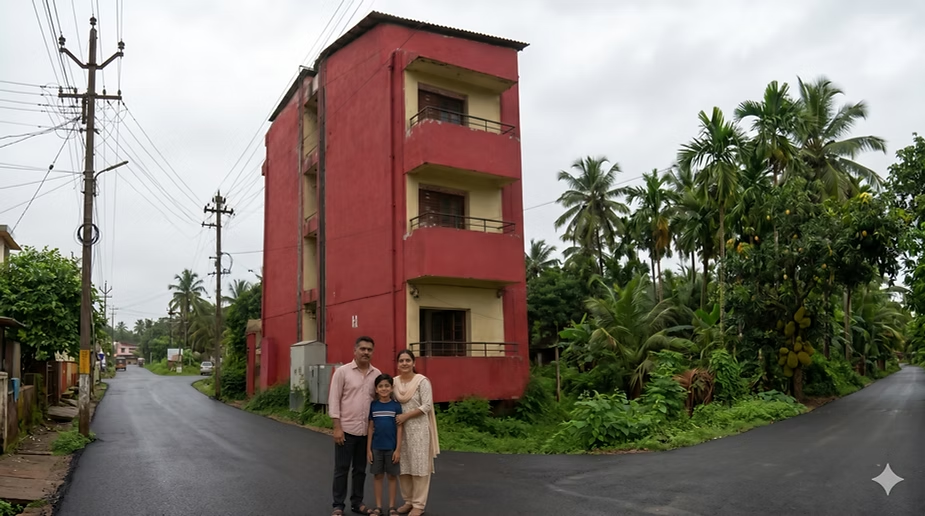
For decades, hundreds of families living in the Goa Rehabilitation Board (GRB) housing complex at Sada in Vasco occupied homes that they could call their own emotionally, but not legally. They raised children there, built communities there, celebrated milestones there and invested years of their lives in these apartments. Yet one crucial element remained missing: ownership.
That long chapter of uncertainty is now drawing to a close.
In a significant development for housing security and social welfare in Goa, more than 350 families residing in GRB housing units at Sada are set to receive legal ownership rights to their flats within the coming month. The announcement, made by Mormugao MLA Sankalp Amonkar and Goa Rehabilitation Board Chairman Rajesh Faldessai, marks the culmination of a process that residents had pursued for years through repeated representations to governments, public officials and local leaders.
The decision is more than an administrative exercise. It represents a transition from occupancy to ownership, from uncertainty to security, and from dependence to empowerment.
For Goa, it is also an example of how governance can directly improve the lives of ordinary citizens by resolving long-pending issues that affect families across generations.
The story of the Sada housing complex is closely linked to Goa’s broader rehabilitation efforts. The Goa Rehabilitation Board was established to address the rehabilitation of displaced persons, disaster-affected families and those impacted by developmental projects. Its mandate includes acquiring land, constructing housing and implementing rehabilitation schemes for affected communities.
Over the years, the Board has played a key role in resettling families affected by infrastructure projects, natural disasters and urban redevelopment initiatives. Sada itself has been one of the important rehabilitation locations in the state. Historical records show that rehabilitation housing in the Sada area was developed for families affected by various public projects and displacement situations. In earlier phases, the Goa Rehabilitation Board constructed housing units for families affected by road widening projects, landslides and other rehabilitation needs.
While the housing units provided shelter and stability, many residents remained without formal ownership documentation for years. As a result, they occupied their homes without enjoying the full legal and financial benefits associated with property ownership.
The consequences of this situation extended far beyond paperwork.
Without ownership rights, residents faced limitations in accessing institutional finance. Banks and financial institutions generally require clear ownership documentation before accepting residential property as collateral. As a result, many families found themselves unable to leverage their homes to obtain loans for education, business expansion, healthcare expenses or home improvements.
Property ownership also influences long-term financial planning. Homes are often the most valuable asset owned by middle-income and economically vulnerable families. The absence of formal title reduces the ability of families to transfer wealth across generations, secure inheritance rights or unlock the economic value of their property.
The announcement by the Goa Rehabilitation Board changes that equation significantly.
According to Board Chairman Rajesh Faldessai, beneficiaries will not only receive ownership rights to the housing units themselves but also rights associated with the land attached to the premises. This aspect is particularly important because it strengthens the legal standing of residents and expands future development possibilities.
Land ownership carries substantial implications. It allows communities to collectively plan for redevelopment, participate in cooperative housing structures and pursue infrastructure improvements. In urban and semi-urban areas, such rights often become the foundation for future modernization and asset enhancement.
For the residents of Sada, this means that the flats they have occupied for years can finally become legally recognized family assets.
The benefits of ownership are likely to be felt across multiple dimensions.
The first is security.
Legal ownership eliminates the uncertainty that often accompanies long-term occupancy without title. Families gain assurance that their homes are legally theirs. This security has both emotional and economic value. It provides peace of mind and strengthens confidence in making long-term investments in property maintenance and improvement.
The second benefit is access to credit.
Property ownership creates opportunities for residents to access formal financial services. Banks are more likely to extend housing loans, educational loans and business financing when borrowers possess legally documented assets. This can stimulate entrepreneurship, improve educational outcomes and support upward mobility among beneficiary families.
The third benefit is redevelopment potential.
Many rehabilitation housing projects across India eventually require modernization, structural upgrades or redevelopment. Ownership rights enable residents to form cooperative societies and collectively participate in decisions regarding repairs, maintenance and redevelopment initiatives. Such flexibility is often critical in ensuring that housing stock remains safe, functional and aligned with changing urban needs.
The fourth benefit is intergenerational wealth creation.
For many families, property ownership is the foundation of long-term economic stability. Legal title allows assets to be transferred to future generations through inheritance, ensuring that the value created today continues to benefit families in the decades ahead.
An important aspect of the Sada initiative is the effort made to ensure affordability.
One of the concerns raised during discussions was the cost associated with obtaining ownership documents. Administrative and registration expenses can sometimes become barriers for economically vulnerable families.
To address this issue, the state government reportedly approved a nominal charge of ₹1,000 per housing unit following intervention and discussions involving local representatives and the Chief Minister.
The matter took an even more significant turn when MLA Sankalp Amonkar announced that he would personally bear the cost on behalf of all beneficiaries, ensuring that no resident would have to pay the fee required for the transfer process.
For families that have already waited decades for ownership rights, removing the final financial hurdle ensures that the benefits can be accessed without additional burden.
The reaction among residents reflects the significance of the announcement.
For many families, the development represents the realization of a long-standing aspiration. Years of uncertainty had led some residents to believe that ownership might never materialize. The prospect of finally receiving official documents has therefore been viewed not merely as an administrative outcome but as recognition of their long-standing association with the community.
This response highlights a broader truth about housing policy.
Housing is not simply about constructing buildings. It is about creating stable communities. Ownership, tenure security and legal recognition are often just as important as the physical structure itself.
Across India, policymakers have increasingly recognized the importance of converting occupancy into ownership where feasible. The logic is straightforward: when residents possess legal rights over their homes, they are more likely to invest in maintenance, participate in community governance and contribute to local development.
The Sada initiative aligns with this wider understanding of housing as a tool for empowerment rather than merely shelter.
From a governance perspective, the development demonstrates the value of resolving legacy issues that may not always attract national attention but have profound local impact.
Large infrastructure projects often dominate public discourse because of their scale and visibility. However, governance is equally measured by the ability to address longstanding citizen concerns, particularly those involving housing, documentation and access to rights.
For the 350-plus families at Sada, the ownership issue was one such concern. It affected daily life, financial planning and future opportunities. Resolving it delivers tangible benefits that can be immediately understood and appreciated by residents.
The announcement also underscores the importance of coordination between elected representatives, government departments and autonomous institutions.
The Goa Rehabilitation Board functions as an important agency responsible for rehabilitation and housing-related interventions in the state. Its mandate extends beyond construction to the broader objective of ensuring successful rehabilitation outcomes.
The ability to move a long-pending ownership process toward completion demonstrates the practical impact of institutional coordination when administrative and political efforts converge around a common objective.
Looking ahead, the Sada experience could serve as a useful reference point for similar housing settlements where occupancy and ownership remain disconnected.
Across many parts of India, residents of government-supported housing projects face challenges relating to title regularization, documentation and property transfer procedures. Successful completion of the Sada ownership process may encourage examination of comparable cases elsewhere and support efforts to extend similar benefits to other eligible communities.
For Goa specifically, the development contributes to a broader narrative centered on housing security, citizen empowerment and inclusive growth.
Housing ownership strengthens families, communities and local economies. It transforms homes into assets, residents into stakeholders and settlements into stable neighborhoods capable of planning for the future.
When the ownership documents are finally handed over, the moment will symbolize more than a bureaucratic achievement. It will represent the completion of a journey that began decades ago when families first moved into these homes.
The buildings themselves may not change overnight.
The streets will remain the same. The neighbors will remain the same. The community spirit that has sustained the colony for years will remain the same.
Yet something fundamental will be different.
For the first time, hundreds of families will possess legal proof that the homes they have lived in, cared for and built their lives around truly belong to them.
That transition—from resident to owner—may well become one of the most meaningful social welfare outcomes witnessed in Vasco this year.
And for more than 350 families in Sada, it marks the beginning of a more secure, empowered and hopeful future.